
Is it a Good Time to Sell a House in Medicine Hat?

Is 2026 a Good Time to Sell a House in Medicine Hat?
Based on the most recent data available, June 2026 figures from the Calgary Real Estate Board's Medicine Hat & Area statistics, the answer leans yes for most sellers. Months of supply has generally sat below 4 months through Q2 2026, and the sales-to-new-listings ratio has been running above 60%. That combination points to seller-favourable or tight balanced conditions, meaning well-priced, well-presented homes are moving, and moving close to asking price.
What the 2026 Medicine Hat Market Stats Actually Tell Sellers
I hear this question all the time: should I list now, or wait? The answer isn't a gut feeling. It's in the data. Here are the four metrics that matter most for seller timing in Medicine Hat right now.
Months of Supply: Still Tight
Months of supply measures how long it would take to sell every active listing at the current sales pace, assuming no new listings entered the market. The Calgary Real Estate Board and the Alberta Real Estate Association (AREA) both treat roughly 4 to 6 months as balanced in Alberta, with anything below 4 months classified as tight or seller-leaning.
Through Q2 2026, Medicine Hat's months of supply has generally sat below that 4-month threshold, according to CREB's Medicine Hat & Area statistics tables for April through June 2026. Inventory is lean relative to buyer demand, and that's good news if you're the one selling.
For the exact June 2026 figure, pull the most recent CREB Monthly Regional Statistics Package and check the Medicine Hat & Area section. Your specific number will depend on property type. Detached homes typically show tighter supply than apartments in this market, so the headline figure may not reflect your exact segment.
Sales-to-New-Listings Ratio: Sellers Are Absorbing Inventory
The sales-to-new-listings ratio (SNLR) tells you what share of new listings are actually selling each month. AREA and CREB treat a sustained SNLR above roughly 60% as a signal of tightening, seller-leaning conditions. Buyers are absorbing new supply quickly, which limits the buildup of competing listings.
In Medicine Hat & Area, the SNLR through Q2 2026 has generally sat above 60%, per CREB's April to June 2026 regional tables. That's a meaningful signal. When a large share of new listings gets absorbed each month, sellers face less competition and buyers have less room to negotiate aggressively on price.
Days on Market: Homes Are Moving Faster Than in 2023
Average days on market (DOM) in Medicine Hat has been trending shorter in late 2025 and into Q2 2026 compared with 2023, according to CREB's Medicine Hat & Area monthly statistics time-series. That compression matters to you as a seller because it means more certainty. You can plan your move-out timeline with more confidence when well-priced homes are typically under contract within a predictable window.
DOM does follow a seasonal pattern in Medicine Hat. Historical data from CREB's 2019 to 2025 Medicine Hat archive shows DOM tends to be lowest in May and June, ticks up in July and August as families vacation, then sees a modest September uptick. If you're reading this in late July 2026, the peak spring compression has passed. That said, you're heading into that September window, which historically brings renewed buyer activity as people aim to get settled before winter.
Sale-to-List Price Ratio: Close to Asking for Most Homes
The Canadian Real Estate Association (CREA) defines the sale-to-list ratio as final sale price divided by list price, averaged across all sales in a period. A ratio near 100% means sellers are achieving close to their asking price. Sustained ratios above 100% indicate frequent over-asking outcomes in competitive segments.
For Medicine Hat, local brokerage market reports for spring 2025 and spring 2026 show the average sale-to-list ratio has often hovered around or just under 100% for typical resale homes. Over-asking outcomes do happen, and they tend to cluster in entry-level price bands and in-demand neighbourhoods during peak months, but they're not universal. Pricing right matters enormously here. In my experience working with sellers across SE Hill, SW Hill, Ross Glen, and the Southridge communities, homes priced accurately from day one consistently outperform homes that start high and chase the market down.
Medicine Hat & Area, Key Market Indicators, Q2 2026 (Latest Available as of July 2026)
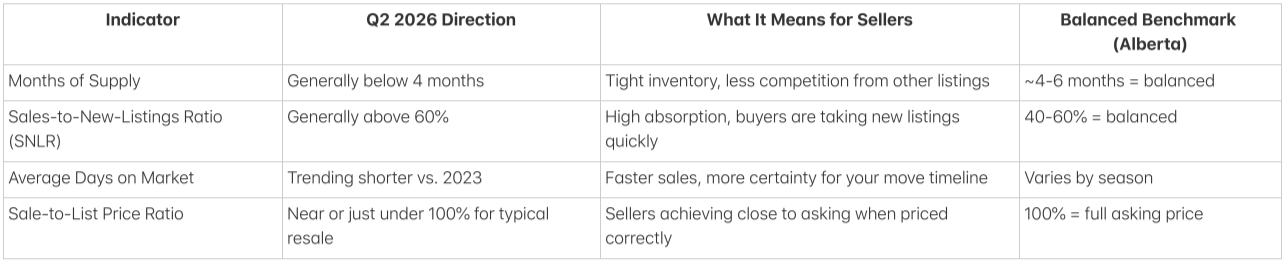
Sources: Calgary Real Estate Board, June 2026 Medicine Hat & Area Statistics; Alberta Real Estate Association, Market Statistics Portal. Figures are directional; pull the exact monthly values from the most recent CREB PDF for precise quoting.
Seasonal Timing: Where You Are in the Medicine Hat Selling Calendar
Market conditions are only half the timing equation. The other half is where you fall in Medicine Hat's seasonal cycle, and that matters more than most sellers expect.
The Spring Peak Is Behind You, But the Fall Window Is Ahead
Historical data from CREA's national and Alberta seasonal sales charts and CREB's Medicine Hat archive (2019 to 2025) consistently shows the same pattern: sales and new listings peak between April and June, DOM hits its low point in May and June, and activity slows markedly from December through February.
As of late July 2026, the spring peak has passed. That doesn't mean you've missed your window. It means you're approaching the next one. Medicine Hat typically sees a September uptick as buyers who spent the summer looking get serious about closing before winter. Listing in August to position for that September activity is a legitimate strategy, particularly for move-up and family-sized homes where buyers want to be settled before the school year is fully underway.
What Happens If You Wait Until Winter?
Here's the honest trade-off. AREA and CREB historical data for Medicine Hat show that December through February brings fewer sales, higher DOM, and more negotiating room for buyers. That sounds discouraging, and there's a flip side: fewer new listings also means less competition for the sellers who do list.
Winter buyers in Medicine Hat tend to be motivated. Job relocations, possession deadlines, and life changes don't pause for the calendar. If you price keenly and invest in strong staging and marketing, a winter listing can absolutely work. If you have flexibility, preparing now and targeting an early spring list date, think late February or early March, positions you to catch buyers who are pre-approved and actively shopping before the spring competition arrives.
This is exactly the kind of timing conversation I walk my clients through before we even set a list date. The data gives us the framework. Your situation, your timeline, your property type, your neighbourhood, shapes the final call.
The Macro Backdrop: Affordability Is Working in Medicine Hat's Favour
One factor that's been quietly supporting Medicine Hat's market through 2024 to 2026 is relative affordability. The CREA Housing Market Outlook and AREA's board-by-board benchmark comparisons both note that Medicine Hat's typical home values sit significantly below Calgary and Edmonton levels. That gap has been attracting move-up buyers and in-migrants from larger centres who find Medicine Hat's price point accessible even in a higher-rate environment.
The Bank of Canada began cutting its policy rate in 2024 and continued into 2025 and 2026, which has gradually improved buyer affordability across Alberta. CREA's 2025 to 2026 national forecasts specifically flagged smaller, affordable Alberta markets as showing resilience, and Medicine Hat fits that profile. Higher borrowing costs haven't eliminated demand here. They've shifted it toward price points where Medicine Hat competes well.
Every market has nuance, though. Detached homes in SE Hill or Ross Glen behave differently than apartments in River Flats or townhomes in Southridge. The only way to know where your specific property sits in the current supply-demand picture is to run a proper comparative market analysis, not an online estimate, which won't account for condition, upgrades, or the micro-dynamics of your street.
How to Position Your Listing for the Best Outcome
Timing gets you in front of buyers. Execution determines what you walk away with.
Here's what I tell every seller who asks me this: the stats create the opportunity, and staging and pricing right in the first week is what converts that opportunity into multiple offers and a fast sale. I believe every listing deserves professional in-house staging, not as an optional add-on, but as a baseline. Buyers form their opinion in seconds, online, before they ever walk through the door. Your listing photos are your first showing.
On marketing: strategic social media and video content put your property in front of serious buyers who are actively researching Medicine Hat, including in-migrants from Calgary and beyond who are doing their homework online before they ever visit in person. That reach matters in a market where out-of-town demand is a real factor.
On pricing: the sale-to-list data tells us that well-priced homes in Medicine Hat are achieving close to asking. That's not an argument for pricing high and hoping. It's an argument for pricing accurately from day one. Homes that start overpriced and reduce tend to sit longer and ultimately sell for less than homes priced right at launch. The Real Estate Council of Alberta (RECA) provides consumer guidance on working with your REALTOR® to understand market value, and that process starts with real, current, local data.
For context on how Real Estate Collective approaches the Medicine Hat market and what our team brings to every listing, you can read more about our roots and commitment to this community here.
Real estate is about people first. The stats tell you when the market is ready. A conversation tells us whether you are, and what the right move looks like for your specific situation.
Frequently Asked Questions: Selling in Medicine Hat in 2026
Is 2026 a good year to sell a house in Medicine Hat, or should I wait?
Based on the most recent data available, June 2026 figures from the Calgary Real Estate Board's Medicine Hat & Area statistics, conditions lean in sellers' favour. Months of supply has generally sat below 4 months and the sales-to-new-listings ratio has been above 60% through Q2 2026, both indicators of a tight or seller-leaning market. Whether waiting makes sense depends on your personal timeline and property type. A local market analysis will give you a clearer picture than the headline numbers alone.
How many months of supply are there in Medicine Hat, and what does that mean for sellers?
Through Q2 2026, Medicine Hat's months of supply has generally sat below 4 months, according to CREB's regional statistics. The Alberta Real Estate Association describes roughly 4 to 6 months as balanced in Alberta, so a reading below 4 months means inventory is lean relative to buyer demand. For sellers, that means less competition from other listings and a stronger negotiating position, provided your home is priced and presented correctly.
What's the sales-to-new-listings ratio in Medicine Hat in 2026? Is it a buyer's or seller's market?
The SNLR in Medicine Hat & Area has generally sat above 60% through Q2 2026, per CREB's April to June 2026 data. AREA and CREB treat a sustained SNLR above roughly 60% as tightening or seller-leaning conditions, meaning a high share of new listings are being absorbed each month. That's a seller-favourable signal, though exact monthly figures fluctuate, so check the most recent CREB Medicine Hat table for the current reading.
How long are homes taking to sell in Medicine Hat in 2026 on average?
Average days on market in Medicine Hat has been trending shorter in late 2025 and into Q2 2026 compared with 2023, according to CREB's Medicine Hat & Area monthly time-series data. DOM also follows a seasonal pattern, historically lowest in May and June, ticking up in July and August, then picking up again in September. For the exact current figure, pull the most recent month's data from the CREB Monthly Regional Statistics Package.
Are houses in Medicine Hat selling close to asking price in 2026, or do buyers expect big discounts?
Local brokerage market reports for spring 2025 and spring 2026 show the average sale-to-list ratio in Medicine Hat has often hovered around or just under 100% for typical resale homes, per CREA's market metrics framework. Sellers who price accurately are generally achieving close to their asking price. Over-asking outcomes do occur in the most competitive price bands and neighbourhoods, but they're not universal. Accurate pricing from day one is the key variable.
When is the best month to list a house in Medicine Hat based on local market stats?
CREB's Medicine Hat & Area monthly archive (2019 to 2025) consistently shows sales volumes peak between April and June, with DOM typically at its lowest in May and June. A late-February or early-March list date positions sellers to catch buyers who are pre-approved and actively shopping before the spring competition builds. If you've missed that window, September is historically the next period of renewed buyer activity in Medicine Hat before the winter slowdown.
How does the Medicine Hat real estate market in 2026 compare to Calgary and other Alberta cities?
Medicine Hat's typical home values sit significantly below Calgary and Edmonton levels, according to AREA's board-by-board benchmark comparisons for 2024 to 2026. That affordability gap has been attracting buyers priced out of larger centres, supporting steady demand in Medicine Hat even as some bigger markets have moderated. CREA's 2025 to 2026 outlook specifically noted resilience in smaller, affordable Alberta markets, and Medicine Hat fits that profile. Always compare Medicine Hat data directly from CREB's regional tables rather than using Calgary figures as a proxy.
Do higher interest rates in 2026 hurt my chances of selling in Medicine Hat, or is demand still strong?
The Bank of Canada began cutting its policy rate in 2024 and continued into 2025 and 2026, gradually improving buyer affordability. CREA's national forecasts noted that smaller, affordable Alberta markets like Medicine Hat have shown resilience even in a higher-rate environment, partly because the price point remains accessible relative to larger cities. Demand in Medicine Hat has stayed steady through Q2 2026, though lending conditions still affect individual buyers. Your agent can help you understand how the current rate environment is shaping offer timelines and condition periods in your specific price range.
The Medicine Hat market data through Q2 2026 points to seller-favourable conditions: tight supply, strong absorption, faster sales, and prices holding close to asking. Your specific outcome depends on your property type, neighbourhood, pricing strategy, and timing within the seasonal cycle. That's where a local market analysis makes the difference between guessing and knowing.
Ready to find out exactly where your home sits in today's market? Schedule a consultation with Elizabeth and the Real Estate Collective team. We'll walk you through the current Medicine Hat numbers and build a strategy around your timeline.
About Elizabeth McNally
Elizabeth McNally is an Elite REALTOR® and team leader at Real Estate Collective in Medicine Hat, Alberta, with 20+ years of experience helping buyers, sellers, and investors across the region. A proud member of a multi-generational Medicine Hat family, she leads a team recognized as #1 small team in Canada for 2023 and 2024 and #1 Medium Team in Canada in 2025 all with REAL BROKER.
Real Broker | Listings courtesy of REAL BROKER. MLS® data via Pillar 9.
Equal Housing Opportunity. Real Estate Collective is regulated by the Real Estate Council of Alberta (RECA). This article is provided for general informational purposes only and does not constitute legal, tax, or financial advice. Market statistics are sourced from CREB and AREA and reflect the most recently available data as of the publish date; conditions change, so confirm current figures and your own numbers with your REALTOR®, attorney, tax advisor, lender, or closing officer before making any real estate decision.